
Table of Contents
India lost by 7 wickets:
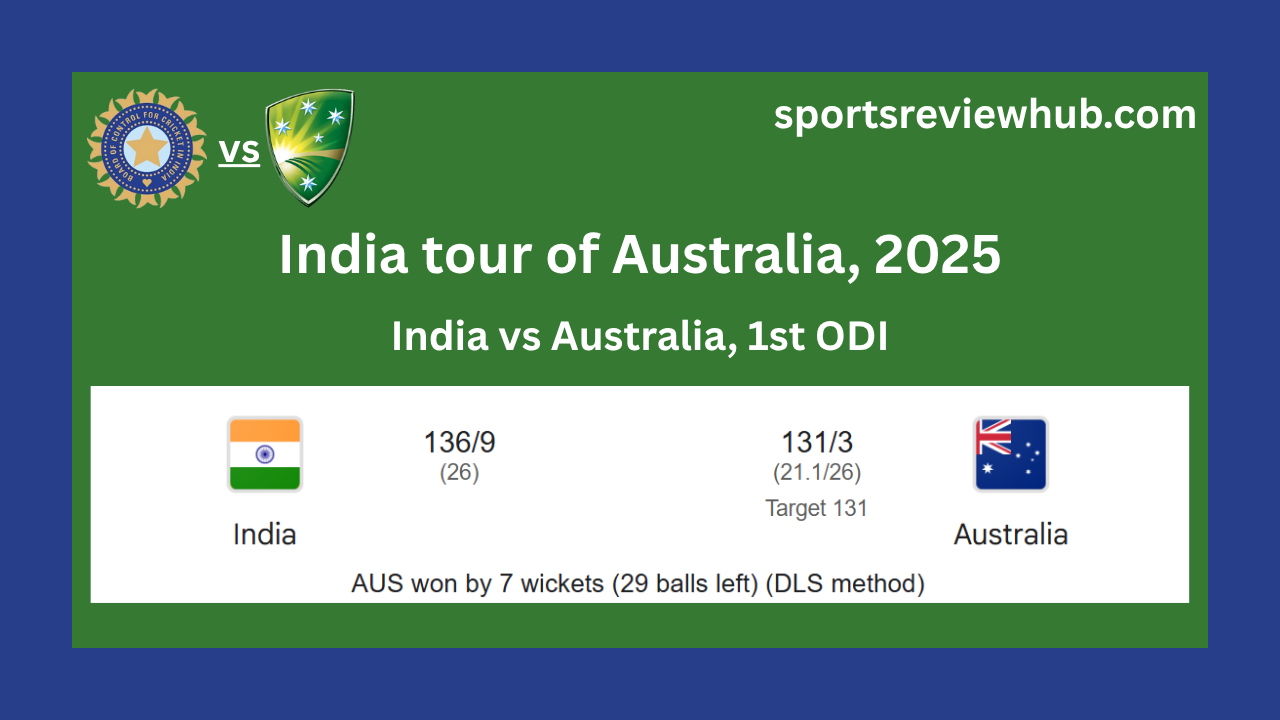
The opening match of the ODI series between India and Australia was interrupted by rain and India lost this match by 7 wickets. This marks India’s first ODI loss of the year. In 2025, India had previously secured victories in all 8 ODIs. Notably, India clinched the Champions Trophy title this year without suffering any defeats. This match also marked Shubman Gill’s debut as captain of the Indian ODI team, and unfortunately, India lost in his first match as captain.
In this video, I will share my insights on the factors contributing to India’s loss in this match, but first, I will provide a brief overview of the match.
The series opener took place at the Optus Stadium in Perth. While the pitch at the new Optus Stadium did not match the quality of the old WACA Ground in terms of bounce, it offered sufficient bounce. Significantly, Australia achieved their first ODI win at the Optus Stadium after four attempts.
India’s innings:
Australia won the toss and chose to field first. The match experienced four rain interruptions, leading to a reduction in overs, and ultimately, each team played 26 overs.
India faced early setbacks, losing crucial wickets at the start of their innings. They lost three wickets for just 25 runs. The two prominent players, Rohit Sharma and Virat Kohli, managed to score only 8 runs and 0 runs, respectively, while Captain Shubman Gill contributed 10 runs. The combination of early wicket losses and frequent rain delays hindered the Indian team’s ability to establish a batting rhythm.
Among the Indian batsmen, KL Rahul and Axar Patel performed admirably. KL Rahul amassed 38 runs from 31 balls, while Axar Patel contributed 31 runs from 38 balls. Following this, Nitish Kumar Reddy made a significant impact towards the end of the innings, hitting two sixes in the final over and finishing with 19 runs not out from 11 balls. After 26 overs, India had a total of 136 runs for 9 wickets.
On the Australian bowling side, Mitchell Owen, Josh Hazlewood, and Matthew Kuhnemann each claimed two wickets. Mitchell Starc and Nathan Ellis secured one wicket apiece.
Australia’s innings:
Despite India scoring 136 runs, Australia’s target for victory was set at 131, rather than 137, according to the Duckworth–Lewis–Stern method, also known as the DLS method. In this match, India needed to take early wickets to secure a win. Arshdeep Singh managed to dismiss Travis Head in the second over, which raised some hopes, but the other opener, captain Mitchell Marsh, played exceptionally well and spearheaded Australia’s run chase. Mitchell Marsh remained not out at 46 runs from 52 balls and was named player of the match. Among the other Australian players, Josh Philippe scored 37 runs off 29 balls, and Matt Renshaw added 21 runs from 24 balls. Australia triumphed by losing 3 wickets in 21.1 overs.
From the Indian bowling contingent, Arshdeep Singh, Axar Patel, and Washington Sundar each took one wicket.
Upcoming ODI matches of this series:
The second ODI of the series is scheduled to take place in Adelaide on October 23. Should Australia win that match, they will clinch the ODI series with one match left, rendering the third ODI less significant. Conversely, if India secures victory in the second ODI, the third ODI will take on the significance of a final match. The third ODI of the series is set to occur in Sydney on October 25.
Five main reasons behind India’s loss:
Now, I would like to briefly outline my thoughts on the five main reasons behind India’s loss in this match, in my view.
- Failure of the top-order batting:
In this match, two of India’s legendary players – Rohit Sharma and Virat Kohli – made their return to international cricket after an extended hiatus. Both Rohit Sharma and Virat Kohli are recognized as not only India’s but also the world’s finest ODI batsmen in history. Unfortunately, they both struggled in this match, with Rohit Sharma scoring just 8 runs and Virat Kohli scoring 0. Additionally, Indian captain Shubman Gill was unable to contribute significantly, managing only 10 runs. India lost these three crucial wickets for a mere 25 runs, putting them under early pressure, which made it challenging for the middle order to cope and accumulate runs in a match affected by rain. - Bouncy pitch and Australian bowling:
The pitch at Optus Stadium in Perth, while not as rapid as the former WACA Ground, still offered considerable speed and bounce, creating difficulties for the Indian batsmen. The Australian fast bowlers, particularly Josh Hazlewood and Mitchell Marsh, capitalized on their height to generate extra bounce, causing issues for the Indian top order. Consequently, India struggled to score runs quickly due to the disciplined bowling of Matthew Kuhnemann.
- Rain interruptions and the DLS system:
The match faced multiple interruptions due to rain, leading to a reduction in overs, which hindered the Indian team’s ability to establish a solid innings. The batsmen were unable to build their innings effectively as the target was cut down from 50 overs to just 26 overs in the end. Furthermore, the repeated rain delays disrupted the batters’ rhythm, giving Australia a significant advantage. Ultimately, India managed to score 136 runs under the DLS rule, but Australia’s target was adjusted down by 6 runs instead of 137, meaning India’s target was effectively reduced by an additional 6 runs.
- Absence of significant partnerships:
India’s highest partnership during the innings was a mere 39 runs between KL Rahul and Axar Patel. Following that, the next notable partnership was 31 runs between KL Rahul and Washington Sundar. Achieving a substantial partnership is crucial for any team aiming to post a high score, and this was evident for India in this match.
- Australia’s remarkable performance:
Australia’s bowlers struck early, taking wickets and curtailing India’s scoring opportunities. With captain Mitchell Marsh remaining unbeaten on 46 and Josh Philippe contributing a brisk 37, Australia found it easy to accumulate runs. In this match, Australia’s overall performance outshone India in both batting and bowling.
I have uploaded a video on YouTube related to the topic discussed in this blog, and you can find the link to that video here: