
Table of Contents
Result:
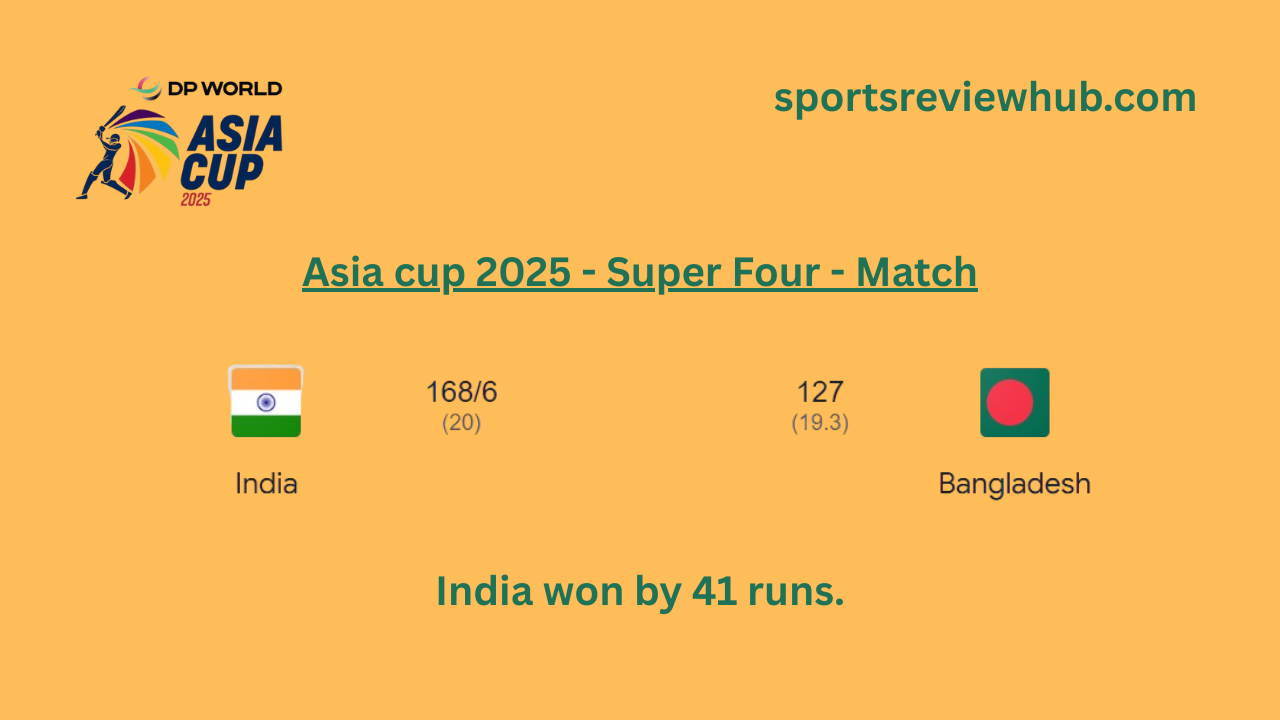
India triumphed over Bangladesh by 41 runs in the Super Four match of the Asia Cup 2025, securing a spot in the tournament final. Although the match ended in a convincing victory, several concerns lingered. Despite the straightforward win by the team widely regarded as potential champions, uncertainties remain for various reasons. Before delving into that, let’s briefly recap the match.
Toss:
Bangladesh won the toss and chose to field first.
India Innings:
The two in-form openers, Abhishek Sharma and Shubman Gill, stepped up to bat for India. They took some time to settle in during the initial two overs of the power play, but soon launched into their characteristic aggressive batting. Thanks to their intense approach, India accumulated seventy-two runs without losing a wicket by the end of the six overs in the power play. However, Shubman Gill was dismissed for thirty-nine runs off nineteen balls. Shivam Dube entered at number three but struggled to make an impact. Meanwhile, Abhishek Sharma continued to play aggressively. By the end of ten overs, India had scored ninety-six runs for two wickets. It appeared at that point that India could well reach two hundred runs. Unfortunately, their batting momentum faltered thereafter. Abhishek Sharma was run out due to a remarkable fielding effort by Rishad Hossain after scoring a brilliant seventy-five runs off thirty-seven balls. He had an early life in the innings: after that, he produced an outstanding aggressive performance. Suryakumar Yadav and Tilak Varma also failed to make significant contributions in this match.
Ultimately, thanks to Hardik Pandya, India finished with one hundred sixty-eight runs for the loss of six wickets in twenty overs. Hardik Pandya managed thirty-eight runs from thirty-nine balls. It was quite surprising that India only scored seventy-two runs for the loss of four wickets in the last ten overs of their innings.
Rishad Hossain stood out as the leading bowler for Bangladesh, claiming two wickets. The Bangladesh team also performed notably in the field, saving multiple boundaries in addition to the run-out of Abhishek Sharma.
Bangladesh Innings:
When Bangladesh came to bat, they had a target of 169 runs to chase. Almost immediately, they lost their first wicket in the second over when Jasprit Bumrah dismissed Tanzid Hasan. Jasprit Bumrah exhibited exceptional swing bowling in this match. After six overs of the power play, Bangladesh had scored forty-four runs for one wicket. After the power play, the Bangladeshi batters found themselves in trouble against the spin bowling of Indian bowlers Kuldeep Yadav and Axar Patel. By the end of ten overs, Bangladesh had managed sixty-five runs while losing three wickets. Even after that, Bangladesh continued to lose wickets, with Saif Hassan shining at one end. Although he dropped four catches during the game, he eventually delivered a solid innings of sixty-nine runs off fifty-one balls. Parvez Hossain Emon was the only other Bangladeshi batsman to reach double figures in this match. Bangladesh’s innings concluded at 127 runs in 19.3 overs, granting India an easy victory by 41 runs.
Kuldeep Yadav emerged as India’s standout bowler in the match, taking three wickets for eighteen runs. Additionally, Jasprit Bumrah and Varun Chakaravarthy claimed two wickets each, while Axar Patel and Tilak Varma each took one wicket.
Player of the Match:
Abhishek Sharma once again received the Player of the Match award for his outstanding batting performance.
Positive things:
India secured a comfortable victory in this match, marking them as the first team to reach the final of the Asia Cup. The opening duo performed well again, with Abhishek Sharma and Shubman Gill putting together a partnership of seventy-seven runs. Abhishek Sharma managed to score over seventy runs once more. Hardik Pandya contributed significantly with his innings towards the end. Following this, India’s bowling was impressive, particularly with Jasprit Bumrah and Kuldeep Yadav delivering excellent performances. These are the positive elements for India from today’s match.
Some concerns:
However, despite this straightforward win, several concerns linger. One such concern is whether India is becoming too reliant on the opening pair, particularly Abhishek Sharma. In the last two matches, after the opening partnership was broken and especially when Abhishek Sharma was dismissed, India’s scoring rate has diminished, and the middle order has faced difficulties. India is set to compete against Sri Lanka in a game that holds little significance before the final, followed by the championship match. Among the middle-order batsmen, although they haven’t had many chances, only Suryakumar Yadav, Sanju Samson, Tilak Varma, and Hardik Pandya have shown promise in a single match each. There is no doubt about the talent in India’s batting lineup, but could the frequent changes in the batting order be affecting the confidence of the middle-order players? For instance, Sanju Samson, who opened for India in the last T20 series, did not get a chance to bat in this match, which saw six players get a turn at the crease. With an upcoming match against Sri Lanka that is almost inconsequential, will we see a more stable Indian batting order in that game?
Another unexpected aspect is India’s fielding. Typically, Indian players are known for taking good catches. However, the team dropped nine catches across two consecutive matches in the Super Four stage. This could become problematic in the final, particularly given the lighting conditions of the Dubai stadium, famously referred to as the ‘Ring of Fire’. It is crucial to address this issue swiftly, as a common saying in cricket states that catches win matches.
I am hopeful that the Indian team will resolve these issues, ultimately bringing home the Asia Cup for the ninth time.
I have uploaded a video on YouTube in Bengali related to the topic discussed in this blog, and you can find the link to that video here: