
Table of Contents
Result and toss:
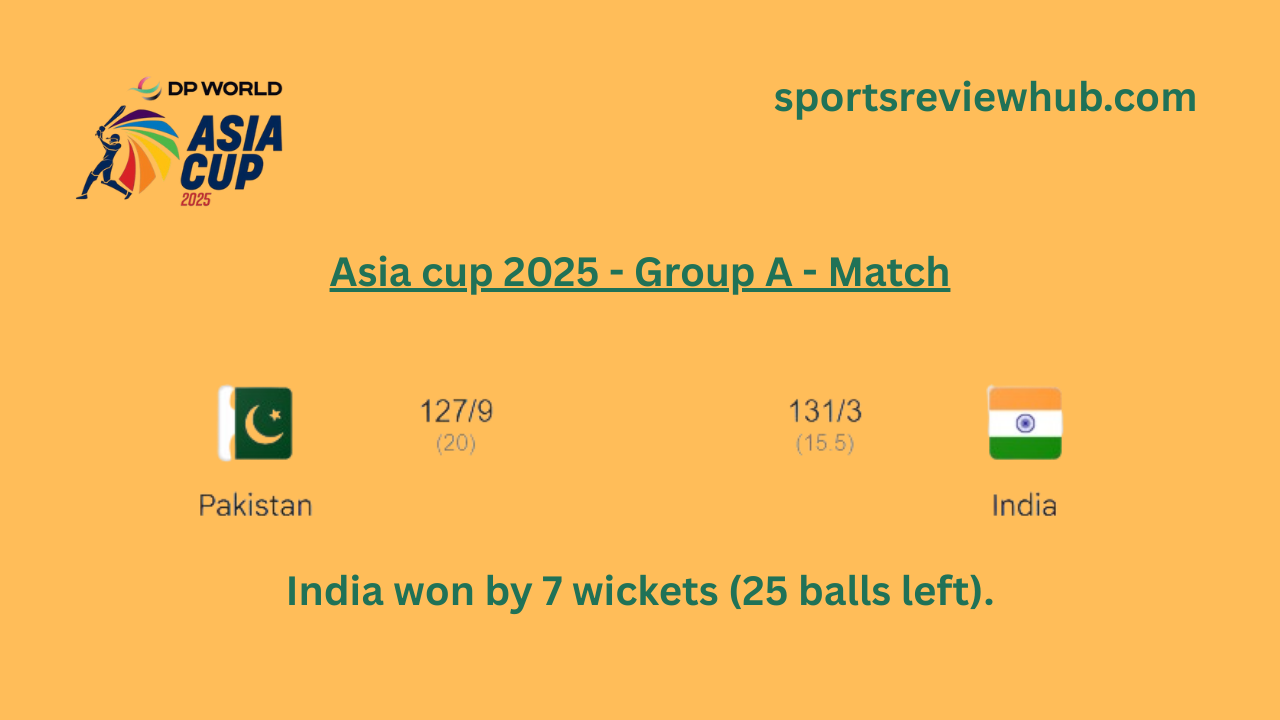
India triumphed over Pakistan by seven wickets in their Group A match of the Asia Cup 2025 held in Dubai. In a match that was largely one-sided, India comfortably defeated Pakistan. While the match lacked competitiveness, off the field, Pakistan ignited controversy following a handshake incident. I will delve into that topic shortly, but first, let’s take a moment to summarize the match.
Pakistan won the toss and opted to bat first. They managed to score 127 runs, losing nine wickets over twenty overs. In response, India chased down the target in just 15.5 overs, losing three wickets in the process.
Pakistan innings:
In the very first over of Pakistan’s innings, Hardik Pandya sent Saim Ayub back to the pavilion for a duck on the first legal delivery of the match, with Jasprit Bumrah taking the catch. The following over saw Jasprit Bumrah claiming the wicket of Mohammad Haris, with Hardik Pandya taking the catch on this occasion as well. After losing two wickets, Sahibzada Farhan and Fakhar Zaman attempted to stabilize their innings. At the conclusion of the powerplay’s six overs, Pakistan was at forty-two for two. In the eighth over, Axar Patel dismissed Fakhar Zaman, who was caught by Tilak Varma. Following the breakdown of this partnership, Pakistan’s middle order crumbled against the Indian spin attack, losing wickets at regular intervals. Kuldeep Yadav was impressive, taking three wickets for eighteen runs off four overs, while Axar Patel claimed two wickets for the same number of runs in four overs. Sahibzada Farhan managed to score forty runs off forty-four balls. Towards the end of their innings, Shaheen Afridi contributed thirty-three runs off sixteen balls, helping Pakistan reach a total of one hundred and twenty-seven runs.
India Innings:
In response, India’s Abhishek Sharma began the innings aggressively, scoring thirty-one runs in just thirteen balls. He struck a four and a six on the first two balls he faced from Shaheen Afridi, establishing a strong start for India’s batting. Shubman Gill was out for ten runs off the last ball of the second over, dismissed by Saim Ayub. Although Abhishek Sharma continued to play aggressively, he too fell to Saim Ayub in the fourth over. However, Suryakumar Yadav and Tilak Varma then formed a partnership of fifty-six runs, steering India closer to victory with consistent singles, twos, and boundaries. Tilak Varma was dismissed for thirty-one runs off thirty-one balls, also at the hands of Saim Ayub. Following that, a thirty-four-run partnership between Suryakumar Yadav and Shivam Dube secured the win for India. Yadav and Dube finished unbeaten at forty-seven and ten runs, respectively. India successfully chased down the target, scoring one hundred and thirty-one runs for the loss of three wickets in fifteen point five overs.
Player of the match:
Kuldeep Yadav was awarded the player of the match for his outstanding performance of three wickets for eighteen runs.
The Indian captain captured the hearts of the nation:
Beyond the on-field competition, Indian captain Suryakumar Yadav captured the hearts of the nation after the match. He conveyed that the team’s conduct was aligned with the directives of the Indian government and the BCCI. He dedicated this victory to the armed forces and the victims of the Pahalgam terrorist attack.
Handshake controversy:
Let’s discuss the situation off the field. When the toss took place, there was no handshake between India’s captain Suryakumar Yadav and Pakistan’s captain Salman Agha. Likewise, after the match, players from both sides did not exchange handshakes. Once victory was secured, India’s unbeaten players Suryakumar Yadav and Shivam Dube headed straight to the dressing room. Typically, players from competing teams are expected to shake hands after the game, though it isn’t a requirement. Recall the previous ODI World Cup held in India in 2023, where Sri Lankan and Bangladeshi players also did not shake hands post-match. In that game, after an appeal from the Bangladeshi players, Sri Lankan all-rounder Angelo Mathews was given a time-out, which led to both teams avoiding handshakes afterward. Moreover, handshakes were also absent during the COVID-19 pandemic.
Thus, teams have the discretion to decide whether to engage in handshakes following the match, depending on any incidents that occur. Now, following their defeat, Pakistan is attempting to emphasize this situation. However, there are no regulations requiring handshakes post-match. The management of the Pakistan team stated that they chose not to send their captain to the post-match ceremony as a form of protest regarding the incident. Nevertheless, this action did not address the situation. While they may not have taken action on the field, something had to be done, leading the Pakistan Cricket Board (PCB) to call for the dismissal of match referee Pycroft from the ICC. They argue that as a match referee, he should not have allowed the captains to refrain from shaking hands. This implies that the PCB believes Pycroft endorsed the lack of handshake, which seems quite absurd.
According to the latest reports, should Pycroft remain in his position, Pakistan might consider boycotting their final group match against the UAE, scheduled for September 17. If this claim holds true, India and the UAE would advance to the Super Four stage from Group A. Let’s wait and see how this unfolds until the end.
I have uploaded a video on YouTube in Bengali related to the topic discussed in this blog, and you can find the link to that video here:
1 thought on “India Dominates Pakistan in Asia Cup Clash and handshake controversy during the toss and after the match”
Comments are closed.